blank'/> Cinema Reviews: review
Showing posts with label review. Show all posts

Wednesday, May 4, 2011

Red Hill - A sloppy cinematic outing (2011)


Dear, oh dear...

Where do I begin? This film, from the producers of Wolf Creek, with at least aspirations to mirror the arid, unsettling atmosphere of The Proposition (Itself a highly flawed picture), falls short of either engaging the viewer in it's revenge story or living up to the Western genre it aspires to be.

The concept is simple and promising; Constable Shane Cooper (True Blood's Ryan Kwanten) moves to the rural town of red Hill, hoping to provide a less stressful environment for his pregnant wife. When a convicted murderer, Jimmy Conway,(Tommy Lewis) escapes from prison, bent on killing every member of the local Police Force, Cooper becomes embroiled in the crossfire between Conway and Sargent Bill (Steve Bisley). Conway was convicted of murdering his wife, but as many cluey viewers will already have guessed by the time Conway emerges, he is an innocent man framed by Bisley's character.

This should have been enough for a compelling revenge movie, with the airless, tension-packed atmosphere of say, No Country for Old men, where we follow two men bent on each other's destruction. Writer-director Patrick Hughes delivers some nice moments, (Conway, like Wolf Creek's Mick Taylor, is an instantly iconic figure; an Aboriginal cowboy whose face is half obscured with deep burn scars. Hughes shoots this stony-faced avenger like a force of nature, with an almost supernatural ability to sense his opponents - witness the scene where he takes out a sniper on a roof, without even having acknowledged his presence with a turn of the head) but none of them are nearly as assured or as well shot as the afore mentioned Coen brother's set pieces.


There are some very clumsy elements in this film (In one scene a character is shot side on through the shoulders? Is Hughes trying show something different with the violence; frankly it's neither darkly amusing nor arresting); the incorporation of a rogue panther stalking Red Hill is laughable and does not serve the plot in any way. Yes, it probably does mirror Jimmy as the rogue element stalking the town but how does it move the story forward? There is a terrible scene where Conway stands coolly in front of an opponent who is apparently so anxious to see him dead that despite firing at him from point-blank range he misses Conway entirely. I did not believe this moment for a second; even an amateur shooter (As indeed the character was) could not have failed to have at least hit him once given the distance suggested by the camera placement. Also, why does Conway possess a psychic ability to sniff out his opponents and hit them with supernatural accuracy in some scenes, yet he can't hit Steve Bisley's character in plain sight in front of a car in another? For me such moments just take you out of the film and cause you to stop investing in the action.

The dialogue is sometimes so laughably B-grade that you pray there's a real moment coming along soon. Such prayers go unanswered as everybody pretty much says whats happening on the surface without ever trying to conceal their intentions and ramp up the tension. In fact the dialogue; which is reasonable at the beginning of the film - take Bisley's unfeeling interrogation of Kwanten's reason's for moving to Red Hill - is superseded by the clumsy action by the second half of the film.

Kwanten is passable, his plain features mirroring a equally plain and uninvolving character.

There was such a missed opportunity with this film. In the hands of a better director, who might have added complexity to the central characters and shaped the action with more style and assurance, this could have been really involving. Instead, it's popcorn fodder for undemanding audiences.

Tuesday, April 19, 2011

PAUL - Frost & Pegg, I'd kiss you right now!


I have literally just got back from the cinema after watching Paul (2011), the new Sci-Fi comedy from the team behind Hot Fuzz and Shaun of the Dead. Stars of those afore mentioned films, Simon Pegg and Nick Frost, were on writing duties for this one, and despite the change of setting to America (And the lack of Director Edgar Wright, who co-wrote Fuzz and Shaun with Pegg, and directed both), their charm and englo-centricity still shines through.

I want to say ahead of time this film absolutely rocked my world, and cheered me up immeasurably. It was so much fun; a joy to watch; I felt like I was sitting down to watch a film with old friends in it.

Frost and Pegg play Sci-Fi fans/nerds Clive Gollings and Graeme Willy respectively. They are on holiday in America, where, after a visit to ComicCon, they take a road trip in an RV visiting UFO hot spots of America. While on route at night, a car crashes in front of them and when inspecting the wreck, they find it's driver, Paul (Voiced by Seth Rogen), an alien (Moulded on the popular 'Grey' species) who has just escaped from Area 51 and is attempting to to get to a certain national monument (Which I wont spoil for those familiar with Close Encounters of a Third Kind) to be picked by the mother ship.

Clive and Graeme agree to help Paul in his journey, unaware they are being pursued by a team of FBI agents (Jason Bateman, Bill Hader and Joe Lo Trugilo) Along the way they are forced to kidnap a staunch Christian woman, Ruth, with a deformed eye (Kirsten Wiig), who becomes Graeme's love interest.

I don't want to say much else about the film's proceedings as I'd rather you discover them for yourselves, suffice to say their are endless pleasant surprises and great lines (Ie in a scene where Ruth's crazed religious Father is vying for road space with an equally crazed Bill Hader, in pursuit of the escaping RV: Father: "I'm on a misson from God!"; "Tell him you failed!" cries Bill Hader, before promptly shooting the Father in the shoulder - don't fret, he lives!)


Paul is a great character; (Seth Rogen in top form) a sarcastic, easy-going stoner alien who dispenses wisdom to a jealous Clive and rattled Ruth, as freely as he adopts invisibility or brings dead birds to life for a snack. The CGI work on his character is great; he literally is just another part of the film, convincing and solid without being distracting or just for the sake of eye-candy.

A recent Empire review complained that there wasn't enough conflict between Clive and Graeme's character's at the start of the film - ala Fuzz and Shuan, where their character traits rubbed against each other - but they're missing the point: Clive and Graeme are meant to be good friends, simpatico, a strong bond BEFORE Paul enters their lives, it's then their secret rivalries come to the fore - i.e Clive's jealousy at Graeme seeming to always be the first to discover or experience something, first Babylon 5 and then Paul himself. Also the scenes where it's just Clive and Graeme on their own are so brief (ComicCon and few scenes on the road)that it really is a petty complaint.


A more valid complaint from my perspective is the overuse of swearing in the film; Kirsten Wiig's character Ruth gets released from her Christian values when Paul shows her his lifetime's knowledge via telepathy; having no moral compass to fall back on she decides, among other things, to swear her head off. While the device is amusing the first couple of times as she is an tragically ineffective swearer: "Fuck-a-roo, that was the best titty-farting sleep I have ever had"; after a while it just starts to grate and feel unnecessary. The fact that other characters like Jason Bateman's icy-cool agent have to start employing this device;"Motherfuckin' tittysuckin' two-balled bitch!" when he runs out of bullets in a scene; is doubly unwelcome and unfunny.

I suppose another complaint you could direct at the film is it's depiction of Christians as one dimensional, gun-totting, bible-thumping idiots in an all out war against Darwinism. It's a fair complaint, but I admire Frost and Pegg for at least taking a side and voicing their opinion, when they could have played it safe. Although it has to be said (And here I agree with Empire) they could have satirized the nerd-dom of ComicCon with a little more bite; they're brave when it comes to mocking Christianity but not their little fan base.

Overall though, there is so much heart, warmth, good humor and good film making to Paul that these are just minor complaints. Director Greg Mottola (Unlike Edgar Wright) does not impose his presence with attention-seeking devices, he keeps the shots simple allowing the charm of the performances to work their magic; only ramping things up in the thrilling chase scene involving a house explosion. Frost and Pegg are, as usual, brilliant - Frost perhaps getting a little bit lazy and studied at times - but they take more a back seat in this one and let their American co-stars have more of a presence.

I loved this film, it made my night; and to that enormous throng of peons waiting to see the latest mind-numbing installment of the Fast & Furious franchise, shame on you, you SO missed out on a great experience.

Friday, April 15, 2011

The Fall - Languid artifice till an emotionally grueling end


The Fall (2006) is sadly a film which only becomes engaging and emotionally satisfying in it's last quarter.

Tarsem (Singh), the mononymous director of this film, is the man responsible for the poorly scripted, acted but lavishly beautiful The Cell starring Jennifer Lopez and Vincent D'Onofrio.

Like that film, The Fall is also elaborately designed; with a gorgeous primary color scheme for the Bandit characters, and clever visual invention; such as the moment when a betraying Preist's face dissolves into a desert landscape with land marks arranged to mirror his features exactly. One feels however that not nearly as much effort and thought went into the design of The Fall as compared to the The Cell, where nearly every moment inside the killers head was filled with dazzling imagery; near bursting at the seams with 'wow' moments, whether macabre or beautiful.

"Perhaps more effort was put into the story; the drama", you ask? Yes, perhaps, but sadly the first two quarters of the film feature rather dull and mawkish moments between a the young protagonist and a stunt man, and a really tepid telling of a story.


The plot deals with a young Romanian girl and an American stunt man, both recovering in a 1920's Los Angeles hospital, from falls they suffered. The girl, Alexandria (Catinca Untaru), has a broken arm from a fall in an orange orchard, and the man, Roy Walker (Lee Pace) has lost the use of his legs. The details of Roy's fall are pertinent to both the story and his mental state:on the set of the film in question, Roy lost his girlfriend to the lead actor, and in attempting to perform a stunt where he would jump from a railway bridge onto a horse, both he and horse end up in the river (In a stunning sepia-tinged opening scene played in slow motion, but unfortunately uses Ludwig van Beethoven's 'Symphony N° 7 in a Major OP.92 - which I cannot listen to now without thinking of the end of Gaspar Noe's Irreversible) In the hospital he and Alexandria form an unlikely friendship, where in exchange for a story: five disparate bandits in search of revenge on a corrupt provincial governor; Roy, deeply depressed, convinces Alexandria to steal a fatal dose of morphine for him.

It is this negotiation, which forms the main thrust of the movie, which lets everything down. The tale Roy tells starts out promisingly enough: imagined sequences, seen in Alexandria's mind, where people from the real world become characters in the story (With even Roy as the principal Black bandit). All five bandits, including a fictionalized Charles Darwin (Leo Bill), are properly motivated against the governor, banished from the kingdom to an island. They escape, and a mystic who emerges from the bowels of a burning tree joins them in their quest (A great scene). Disappointingly, from that point on, the tale descends into slow moving sequences with no tension (The bandits go here, they go there, capture a nun, no-one makes any great attempt to stop them, we are left in no doubt they will succeed...), and self-conscious, stylized acting from Lee Pace in the romantic moments which I found off-putting, rather than I assume the intended humorous, self-aware effect. These story sequences could have had the whimsy, fun and adventure of Terry Gilliam's much more successful, (Forget the critics or the box office - the film is great) The Adventures of Baron Münchhausen, instead the bandits lack any special attributes which might make them interesting, and the tale is dull.


The interactions between Roy and Alexandria are the second weakest link in this section: the debut appearance of Catinca Untaru does not endear; her constant interruptions over Lee Pace ensure these scenes looks improvised (Which I'm certain they were, the intention probably being to make them seem more natural; as children do interrupt people - well fine, but it's also bloody annoying when they do that! Which is precisely the effect achieved by this device), unpolished and un-engaging. Because of this there are no dynamics in their scenes together, no followable progression in the tightening of their relationship; they don't grow closer so much as keep yammering at each other.

All of this however, can be largely forgiven for the extremely satisfying - but grueling - last quarter of the film. Roy flips out after his attempted suicide is thwarted by morphine pills Alexandria got from a nieghbouring patient - evidently the Doctors were giving the man placebos - so Alexandria steals into the dispensary to obtain more pills for Roy (Unaware at all times that he wants to kill himself). She falls, and here Tarsem's skills finally come to the fore: instead of Alexandria hitting the floor, Roy as the masked bandit falls to the floor, missing a leg, a false leg falls after him and shatters on the ground. We then cut to several vignettes of Roy as masked bandit, Roy as a gladiator, Roy as a knight, all having their legs dismembered. The sequence represents the presumably unconscious Alexandria, tumbling through her own mind, her imagination and memories overlapping to form associations between real life and the story; her Father's death and their house burning down; her fall from the orange tree. As clunky as some of the ideas sound, the sequence is genuinely distressing, especially in contrast to the very light-hearted first two thirds of the film. Tension, and thus our interest, finally enter the film. We are even treated to some dark stop motion animation as Alexandria imagines the Doctor's operating on her her fractured skull, and she hears Roy being chastised by the Medical staff for his abuse of her trust. This is the kind of visual detail and audio layering that made The Cell so engaging.

When Alexandria awakes, Roy is by her side, and through his subsequent abuse of the continuing story, she must finally confront the distressed mind that has been lurking behind Roy's outward shows of friendship. Roy is drunk, and as he continues the story, he starts killing off all the bandits in increasingly distressing ways, and despite Alexandria's plees for him to stop Roy continues, before finally his character, the Black Bandit, is the only one left to confront the governor. The scene is disturbing because we know and understand why Roy is acting like this; a heart broken man, depressed and fixated with death; but we are also aware that Alexandria does not understand, and for Roy to be exposing her to this very adult and dark behavior appalls us. We worry for her and while concerned for Roy, morally we demand him to stop torturing this poor child. It is this kind of tension and complexity that is lacking in almost every other frame of the film.

After having the Black Bandit brutally beaten up by the governor, and the character essentially give up on trying to fight back, Roy nearly has him drowned. In doing so he breaks all of Alexandria's childhood illusions of honor and justice, and indeed, her impressions of Roy himself. Again, it is this traumatizing of Alexandria, and exposure to adult concepts entirely inappropriate to her age - from an adult who should know better - which deeply moves and conflicts us as viewers. Finally Roy listens to Alexandria's pleas to let the Black Bandit live, and in doing so he decides to live as well, redeeming himself.

Almost all of the tepid, elaborate puffery from earlier is worth having sat through for this scene, and I wish more films could have as many complex ideas, moral quandaries and emotions as there are in this scene. It is deeply satisfying as an audience member.

Overall, a beautiful film, but not as beautiful as The Cell; a great ending but a shallow first two-thirds.

Monday, April 11, 2011

Legend of the Guardians: The Owls of Ga'Hoole - Exceptionally beautiful but not a classic


You can certainly say one thing for director Zack Snyder, he knows how to create beautiful images. There is not one second of this film (Legend of the Guardians: The Owls of Ga'Hoole (2010)where you don't marvel at the qualities of the light (Especially that glorious earthy, amber dusk light that permeates the film), the clarity of each individual feather bristling on the title characters, the epic panoramas surrounding the owls in flight, the hellish red glare of a hungry Tasmanian devil on a forest floor, the quality of the movement in the animation; it all lovingly kisses your vision.

The only visual trick overused by Snyder is his insistence on speed ramping ("ramping", is a process whereby the capture frame rate of the camera changes over time. For example, if in the course of 10 seconds of capture, the capture frame rate is adjusted from 60 frames per second to 24 frames per second, when played back at the standard film rate of 24 frames per second, a unique time-manipulation effect is achieved"), and it's often disorientating effect on the battle scenes at the end of the film. Personally I would like to see the action Animal Logic's (The Company responsible for Happy Feet) team has clearly spent so much time animating.

Guardians is a story of sibling rivalry, betrayal and faith set against the back drop of an ancient feud between legendary rival owl tribes, the evil Pure Ones and the heroic Guardians. Owl brothers Soren and Klud (Voiced by Jim Sturgess and Ryan Kwanten [Of vampire series 'True Blood' fame] respectively) stray from the nest trying to out fly each other, only to be captured by members of the Pure Ones, a tribe of Owls who 'moon blink' their captives into mindless drones to collect magical metal that affects the gizzards or 'souls' or owls, incapacitating them. Soren and an Elf Owl called Gylfie (Emily Barclay - who played that hideous hyena in the overrated Suburban Mayhem; a far cry from her diminutive, endearing character here) join forces to escape, but Klud ultimately sides with the Pure Ones, under the leadership of Metalbeak (Played by an vocally unrecognizable Joel Edgerton - in the sense that you wont recognize either his voice or what type of accent he's meant to be using - what the heck is it; English, Australian, American?)


Soren seeks out the help of the Guardians, an owl tribe described to him by his Father and whose heroic tales have always inspired him. In the course of doing so he learns that battle is not as glamorous as the stories led him to believe, but that honor and self belief can be.

It's hard to say exactly why this film doesn't quite reach 'Classic' status. I was absolutely rapt for the first three quarters of the film; was involved in the sweet partnership of Soren and Gylfie; but when more characters were into the mix (Annoying unnecessary comic relief in the form of Digger (David Wenham) and Twilight (Anthony Lapaglia), and after the Guardians were located, the film lost it's tension, and the manner in which a fellow Gaurdian betrays the tribe is not satisfactorily played out for the dramatic impact it could have had. Metalbeak is also a pretty passive villain; initiating plans behind the scenes yes, but largely just skulking about in the foreground looking dark and mysterious, emerging only to fight in the battle between the Guardians and the Pure Ones at the end of the film. It must be said of that fight that despite the swords and knives and armory strapped to the owls the conflict is lackluster - not because of a lack of gore; understandable given this is a children's film - but because of uninspired staging and Snyder's obscuring speed ramping.

Again, the Australian landscape and it's fauna look amazing, and it was great to see so many Australian actors voicing the characters; among them Bill Hunter, Hugo Weaving, Geoffrey Rush, Angus Sampson and Abie Cornish - though why they felt it necessary to include English accents and actors (Helen Mirren, Miriam Margolyes) as well is beyond me; international appeal, then why not American accents Ala 'Chicken Run'?


Soren as the title character is a bit of a wet blanket, but his enthusiasm and goodness is endearing. I might be expecting too much from an animated children's film, but I was just so swept away by the first three quarters of the film that to descend into such a tried-and-tested battle scenario just seemed a waste of the good will generated by the start. It is a very unusual, eccentric (Owls in Armour), even occasionally dark children's film, and as such it would have to been nice to see the film makers push that uniqueness even further, into a less conventional story line.

Overall spectacular visuals, great first three quarters but lacking in a satisfying dramatic high point or conclusion.

Friday, November 5, 2010

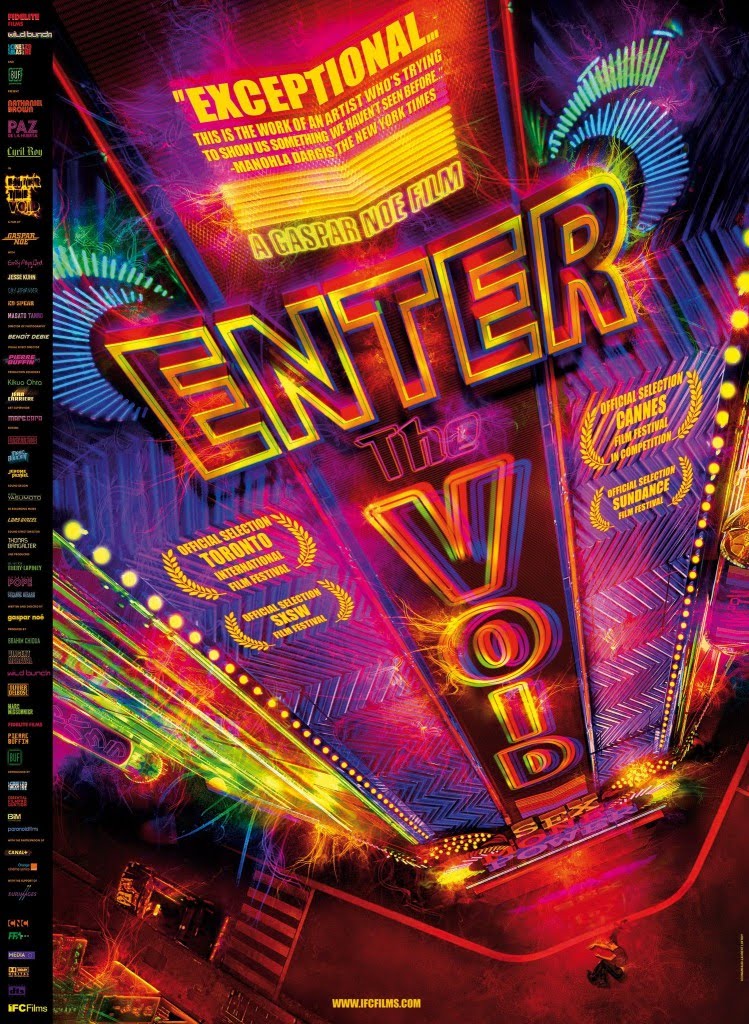
Gaspar Noe's "Enter the Void" - Brilliant, but too bloody long!


The two main feelings I left with after seeing Gaspar Noe's Enter the Void last night at a screening at the Canberra International Film Festival (One of a few across the country as the film is getting no general Australian Release), were A) I had seen something amazing and B) It was so tortuously self-indulgent and long that at times I wanted to shake my fist at the screen in anguish.

The film IS a technical marvel, taking a use of CGI started by David Fincher in Panic Room (And obviously in Noe's own Irreversible) to expand the limits of where a camera can move through space to their absolute limit, so that we literally see through the eyes of the main character Oscar (Nathaniel Brown) without any compromises such as avoiding mirrors, looking through spy holes, smoking a crack pipe, blinking, or his own hands passing over his face. Later, with the camera as the eyes of Oscar's disembodied spirit we float effortlessly over the rooftops of buildings and through physical matter such as buildings, walls and rooms (A great shot in this vein happens just after Oscar's murder where friend Alex (Cyril Roy) tussles with Police and exits from frame, and seconds later we are whisked over a building following the sound of Alex's voice and chase him down an alleyway in an overhead shot as he runs from the scene - the sense of momentum and movement in this shot is just breath taking) We dive into bullet wounds, drains, urns, lights and emerge from similar objects as though they are physically linked by unseen tunnels (Or spaces of mottled strobing); we sink into the back of people's heads and observe things through their eyes, as well as passing through interior spaces of their bodies; we even change from wide lenses to fish-eye lenses without a single cut, in fact there is NO cut in this film, a marvel in itself; any blackness is created by moving into low light and Oscar's blinking or closing of eyes.

The camera is also enabled to switch rapidly through time - in the latter half of the film where Oscar's spirit reviews his memories - where we switch seamlessly between bath times in the past for Oscar, his sister Linda (Paz de la Huerta) and their Mother (Disappearing below the water line), to more recent times where older Oscar bathes with older Linda (Reappearing above the water line). This device allows for beautiful Freudian moments (i.e. unconscious connections made in the mind) such as when we switch back and forth between Oscar's POV in an affair with an older woman, Suzy (Sara Stockbridge) reaching for her naked breasts, and Oscar's POV as a baby's, reaching for his Mother's breasts.
Another stand out moment for this device, although used for dramatic impact and not in a Fruedian sense (And If you're still awake for it, that is), is near the end of the film when Oscar's spirit rides with Linda and his friend Alex in a taxi headed for a Japanese Love Hotel, and Linda, inexplicably and contrary to the tone of the scene, screams into Alex's face and we spin round as a truck collides with the front of the vehicle - we are now looking at a scene in the past through young Oscar's eyes, as he stares at the mangled, bloody reclining faces of his dead parents, killed in a head-on collision (Noe replays this accident several times throughout the movie, lingering on the mangled corpses; obviously signposting it as an important memory in Oscar's recollections, but probably more so to shock and rattle the viewer. It is a misguided effort however, for as a result of Noe's own excesses with Irreversible's violent rape scene and in this climate post Hostel films, what really is left in terms of the viler aspects of human nature and tragedy for filmmakers to expose on film and still hope for a reaction? Overuse has meant I simply find this apparently transgressive device tedious)


CGI is additionally used to augment the colors of every scene, so that the film is literally one pulsing, lurid, neon splash of light - stand out moments of these include the blazing, kinetic opening titles (Starting from the use of Irreversible's primary colored titles on black and end credit music [Which I thought was a bit on the nose: 'Oh, hey everyone, this sequence is a direct continuation from my last film', but anyway...] and cutting straight into Neon-sign like signatures for actors and production crew); Oscar and Linda's visit to some sort of ornamental shop where everything glows with phosphorescent greens, blues, yellows, oranges and pinks; the exterior facade and pole dancing floor of the Sex, Money, Power Nightclub where Linda works as stripper; and the lights of the Police and Emergency Vans after Oscar is shot. You can see how Marc Caro's (Who co-directed Delicatessen & The City of Lost Children with Jean-Pierre Jeunet) art direction really lifted this film's look to another level.

A fourth use of CGI is to ornament the film with incredible imagined images, such as the amazing hallucinations Oscar experiences after smoking DMT (The chemical released from the pineal gland moments before death, as is explained to Oscar by Alex in an early scene), where his view of the room he and Linda shares becomes overlaid with CGI images of strange splintering, undulating formations like DNA strands or geometric weed; again neon-colored and with electricity cycling along their stems. Additionally Noe uses ornamentation on the buildings behind the Love Hotel late in the film, getting them to pulse and undulate and defy perspective in unnatural ways. Another great moment is when Oscar returns to his body at the scene of his murder, and in a reverse of the shot that accompanied his death the first time around, moving up into the light; we pull back from his body into some kind of undulating, visceral tunnel, where the light should be, gradually having our view of Oscar's body obscured by the bends in the writhing tunnel. A great visual and thematic moment is when we glide through the various rooms of the Love Hotel where various Japanese people are copulating, CGI adding streams of incandescent, spectral light from their sex organs, and sending similar light across their bodies. Here Noe of course is suggesting the power and mystery of the sexual act. CGI also creates the buzzing, mottled, faded papyrus-like colored spaces of strobing we encounter when Oscar's spirit zooms into various household or street lights - which also seem to contain the splintering geometric hallucinations from earlier; but heavily obscured and difficult to focus on. I can only assume that these spaces are meant to represent apertures to heaven or possibly purgatory, as this is the first space Oscar finds after leaving his body, disappearing into the light fixture in the roof of the toilet he is is shot in. When we leave them, perhaps this is Oscar's spirit deciding not to move on from the physical world - a decision it debates several times over through the use of this device during the film.


But this incredible technical mastery aside, the biggest problem with the film is that Gaspar believes his plot and actors are more engaging than they actually are; call it a moral judgment, but dense drug users breezing around the streets of Tokyo, alternating between a comatose delivery of dialogue or histrionic, unsympathetic caterwauling, are not the kind of people I wish to spend much time with - but of course I realize a lot of people will.

I've already given you snippets, but I should probably now address the story line. Oscar and Linda, brother and Sister, live together in Tokyo, following the death of the parents years earlier. Linda works as a dancer at a local strip joint and Oscar is a drug dealer. After taking smoking some DMT and talking to his friend Alex about the Tibetan book of living and dying, Oscar is betrayed by a customer, Victor, and Japanese Police shoot him in the toilet of a bar. His spirit leaves his body and flies over the city, observing the fallout of his death on the lives of his sister and friends.

There is very little in the way of plot from this point on, just a series of either past events, Oscar's memories, present day events and arresting visual moments as Oscar's spirit journeys over Tokyo city.


Some devices employed by Noe simply suffer from overuse - and I mean OVERuse - the down shot flying through buildings which link us to events and characters across the city is great the first four times we see it, but soon wears out it's welcome. Disappearing into the lights into fields of strobing is very arresting the first few times it's used, but become tedious once we enter them again...and again. Having the scenes we witness start to strobe and shudder in a fish-eye perspective is quite startling the first two times we see it - but loses any impact (And tries the patience) with repeated use. The biggest problem is that none of the above devices seem to add any further level of meaning to the story, or even to push the story forward - they seem almost like eye candy for the sake of it or flashy band aids to synch two scenes together. It is, quite simply, lazy film making - especially for the amount of work the tech crew would've put into rendering them.

Even the device of moving to different time frames and places, loses it's impact from overuse. After a certain point - let's say about an 1 hour and bit in, when Oscar is deeper into his memory recall of past experiences - you just stop caring and switch off. The film becomes more of a endurance test, waiting with grit teeth for something interesting to come on again, or hopefully, for the film to end.

I should be fairer in many respects, as this was an experimental film, with little to no scripted dialogue and detailed descriptions of what would happen. Noe was probably trying out a lot of stuff simply to see if it would work, but the fact remains he didn't have to include the failed sequences (If he even recognized them as flawed, that is), or ALL of the sequences, as so much on screen is unnecessary; from Linda's unsympathetic wailing when Victor comes to apologize for setting Oscar up, to Alex's weeks on the street after Oscar's death (I'm sorry, the guy's a moron and I just don't care), -  Perhaps Noe is suggesting that the reality of people grieving is LOONG, tedious and exhausting, and obviously this is a valid point - but this observation doesn't make for a very engaging film. Perhaps Noe, the irreligious, nihilist provocateur such as he is, doesn't really care if this is the result. I certainly hope he cares, as his statement from promotional material seems to imply here


Enter the Void was an amazing, irritating experience; my first film festival experience; and as stunning as some of it's visual moments are, it is a flawed, lazy film and as such I couldn't embrace the experience wholeheartedly.