Showing posts with label alternative. Show all posts
Friday, April 15, 2011
The Fall - Languid artifice till an emotionally grueling end
The Fall (2006) is sadly a film which only becomes engaging and emotionally satisfying in it's last quarter.
Tarsem (Singh), the mononymous director of this film, is the man responsible for the poorly scripted, acted but lavishly beautiful The Cell starring Jennifer Lopez and Vincent D'Onofrio.
Like that film, The Fall is also elaborately designed; with a gorgeous primary color scheme for the Bandit characters, and clever visual invention; such as the moment when a betraying Preist's face dissolves into a desert landscape with land marks arranged to mirror his features exactly. One feels however that not nearly as much effort and thought went into the design of The Fall as compared to the The Cell, where nearly every moment inside the killers head was filled with dazzling imagery; near bursting at the seams with 'wow' moments, whether macabre or beautiful.
"Perhaps more effort was put into the story; the drama", you ask? Yes, perhaps, but sadly the first two quarters of the film feature rather dull and mawkish moments between a the young protagonist and a stunt man, and a really tepid telling of a story.
The plot deals with a young Romanian girl and an American stunt man, both recovering in a 1920's Los Angeles hospital, from falls they suffered. The girl, Alexandria (Catinca Untaru), has a broken arm from a fall in an orange orchard, and the man, Roy Walker (Lee Pace) has lost the use of his legs. The details of Roy's fall are pertinent to both the story and his mental state:on the set of the film in question, Roy lost his girlfriend to the lead actor, and in attempting to perform a stunt where he would jump from a railway bridge onto a horse, both he and horse end up in the river (In a stunning sepia-tinged opening scene played in slow motion, but unfortunately uses Ludwig van Beethoven's 'Symphony N° 7 in a Major OP.92 - which I cannot listen to now without thinking of the end of Gaspar Noe's Irreversible) In the hospital he and Alexandria form an unlikely friendship, where in exchange for a story: five disparate bandits in search of revenge on a corrupt provincial governor; Roy, deeply depressed, convinces Alexandria to steal a fatal dose of morphine for him.
It is this negotiation, which forms the main thrust of the movie, which lets everything down. The tale Roy tells starts out promisingly enough: imagined sequences, seen in Alexandria's mind, where people from the real world become characters in the story (With even Roy as the principal Black bandit). All five bandits, including a fictionalized Charles Darwin (Leo Bill), are properly motivated against the governor, banished from the kingdom to an island. They escape, and a mystic who emerges from the bowels of a burning tree joins them in their quest (A great scene). Disappointingly, from that point on, the tale descends into slow moving sequences with no tension (The bandits go here, they go there, capture a nun, no-one makes any great attempt to stop them, we are left in no doubt they will succeed...), and self-conscious, stylized acting from Lee Pace in the romantic moments which I found off-putting, rather than I assume the intended humorous, self-aware effect. These story sequences could have had the whimsy, fun and adventure of Terry Gilliam's much more successful, (Forget the critics or the box office - the film is great) The Adventures of Baron Münchhausen, instead the bandits lack any special attributes which might make them interesting, and the tale is dull.
The interactions between Roy and Alexandria are the second weakest link in this section: the debut appearance of Catinca Untaru does not endear; her constant interruptions over Lee Pace ensure these scenes looks improvised (Which I'm certain they were, the intention probably being to make them seem more natural; as children do interrupt people - well fine, but it's also bloody annoying when they do that! Which is precisely the effect achieved by this device), unpolished and un-engaging. Because of this there are no dynamics in their scenes together, no followable progression in the tightening of their relationship; they don't grow closer so much as keep yammering at each other.
All of this however, can be largely forgiven for the extremely satisfying - but grueling - last quarter of the film. Roy flips out after his attempted suicide is thwarted by morphine pills Alexandria got from a nieghbouring patient - evidently the Doctors were giving the man placebos - so Alexandria steals into the dispensary to obtain more pills for Roy (Unaware at all times that he wants to kill himself). She falls, and here Tarsem's skills finally come to the fore: instead of Alexandria hitting the floor, Roy as the masked bandit falls to the floor, missing a leg, a false leg falls after him and shatters on the ground. We then cut to several vignettes of Roy as masked bandit, Roy as a gladiator, Roy as a knight, all having their legs dismembered. The sequence represents the presumably unconscious Alexandria, tumbling through her own mind, her imagination and memories overlapping to form associations between real life and the story; her Father's death and their house burning down; her fall from the orange tree. As clunky as some of the ideas sound, the sequence is genuinely distressing, especially in contrast to the very light-hearted first two thirds of the film. Tension, and thus our interest, finally enter the film. We are even treated to some dark stop motion animation as Alexandria imagines the Doctor's operating on her her fractured skull, and she hears Roy being chastised by the Medical staff for his abuse of her trust. This is the kind of visual detail and audio layering that made The Cell so engaging.
When Alexandria awakes, Roy is by her side, and through his subsequent abuse of the continuing story, she must finally confront the distressed mind that has been lurking behind Roy's outward shows of friendship. Roy is drunk, and as he continues the story, he starts killing off all the bandits in increasingly distressing ways, and despite Alexandria's plees for him to stop Roy continues, before finally his character, the Black Bandit, is the only one left to confront the governor. The scene is disturbing because we know and understand why Roy is acting like this; a heart broken man, depressed and fixated with death; but we are also aware that Alexandria does not understand, and for Roy to be exposing her to this very adult and dark behavior appalls us. We worry for her and while concerned for Roy, morally we demand him to stop torturing this poor child. It is this kind of tension and complexity that is lacking in almost every other frame of the film.
After having the Black Bandit brutally beaten up by the governor, and the character essentially give up on trying to fight back, Roy nearly has him drowned. In doing so he breaks all of Alexandria's childhood illusions of honor and justice, and indeed, her impressions of Roy himself. Again, it is this traumatizing of Alexandria, and exposure to adult concepts entirely inappropriate to her age - from an adult who should know better - which deeply moves and conflicts us as viewers. Finally Roy listens to Alexandria's pleas to let the Black Bandit live, and in doing so he decides to live as well, redeeming himself.
Almost all of the tepid, elaborate puffery from earlier is worth having sat through for this scene, and I wish more films could have as many complex ideas, moral quandaries and emotions as there are in this scene. It is deeply satisfying as an audience member.
Overall, a beautiful film, but not as beautiful as The Cell; a great ending but a shallow first two-thirds.
Friday, November 5, 2010
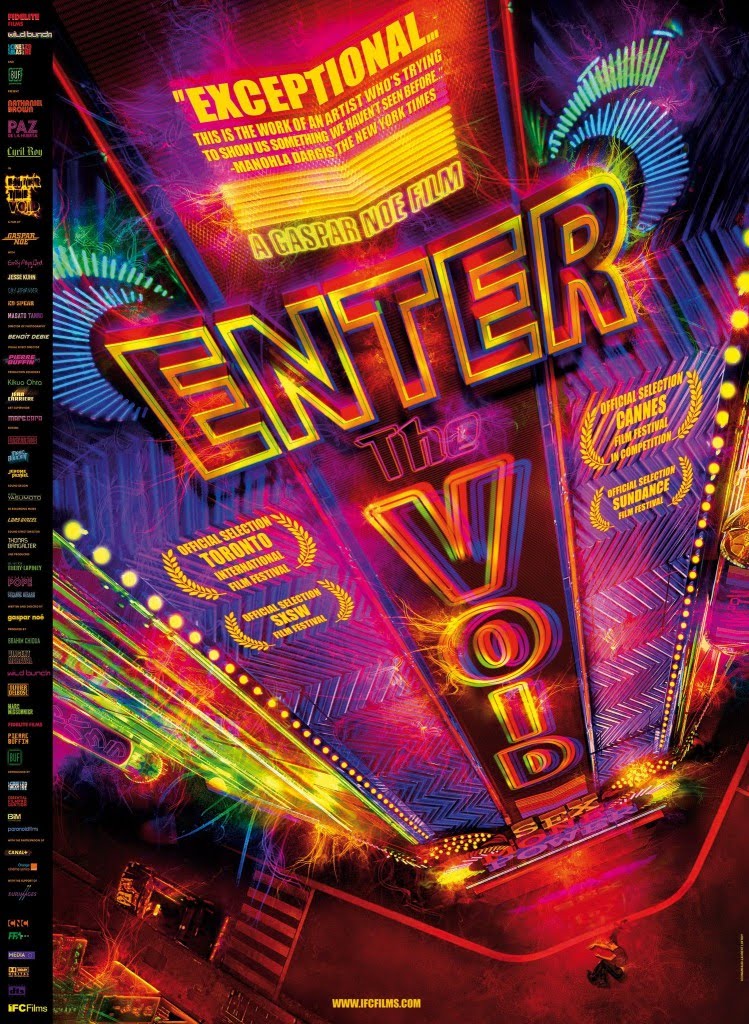
Gaspar Noe's "Enter the Void" - Brilliant, but too bloody long!
The two main feelings I left with after seeing Gaspar Noe's Enter the Void last night at a screening at the Canberra International Film Festival (One of a few across the country as the film is getting no general Australian Release), were A) I had seen something amazing and B) It was so tortuously self-indulgent and long that at times I wanted to shake my fist at the screen in anguish.
The film IS a technical marvel, taking a use of CGI started by David Fincher in Panic Room (And obviously in Noe's own Irreversible) to expand the limits of where a camera can move through space to their absolute limit, so that we literally see through the eyes of the main character Oscar (Nathaniel Brown) without any compromises such as avoiding mirrors, looking through spy holes, smoking a crack pipe, blinking, or his own hands passing over his face. Later, with the camera as the eyes of Oscar's disembodied spirit we float effortlessly over the rooftops of buildings and through physical matter such as buildings, walls and rooms (A great shot in this vein happens just after Oscar's murder where friend Alex (Cyril Roy) tussles with Police and exits from frame, and seconds later we are whisked over a building following the sound of Alex's voice and chase him down an alleyway in an overhead shot as he runs from the scene - the sense of momentum and movement in this shot is just breath taking) We dive into bullet wounds, drains, urns, lights and emerge from similar objects as though they are physically linked by unseen tunnels (Or spaces of mottled strobing); we sink into the back of people's heads and observe things through their eyes, as well as passing through interior spaces of their bodies; we even change from wide lenses to fish-eye lenses without a single cut, in fact there is NO cut in this film, a marvel in itself; any blackness is created by moving into low light and Oscar's blinking or closing of eyes.
The camera is also enabled to switch rapidly through time - in the latter half of the film where Oscar's spirit reviews his memories - where we switch seamlessly between bath times in the past for Oscar, his sister Linda (Paz de la Huerta) and their Mother (Disappearing below the water line), to more recent times where older Oscar bathes with older Linda (Reappearing above the water line). This device allows for beautiful Freudian moments (i.e. unconscious connections made in the mind) such as when we switch back and forth between Oscar's POV in an affair with an older woman, Suzy (Sara Stockbridge) reaching for her naked breasts, and Oscar's POV as a baby's, reaching for his Mother's breasts.
Another stand out moment for this device, although used for dramatic impact and not in a Fruedian sense (And If you're still awake for it, that is), is near the end of the film when Oscar's spirit rides with Linda and his friend Alex in a taxi headed for a Japanese Love Hotel, and Linda, inexplicably and contrary to the tone of the scene, screams into Alex's face and we spin round as a truck collides with the front of the vehicle - we are now looking at a scene in the past through young Oscar's eyes, as he stares at the mangled, bloody reclining faces of his dead parents, killed in a head-on collision (Noe replays this accident several times throughout the movie, lingering on the mangled corpses; obviously signposting it as an important memory in Oscar's recollections, but probably more so to shock and rattle the viewer. It is a misguided effort however, for as a result of Noe's own excesses with Irreversible's violent rape scene and in this climate post Hostel films, what really is left in terms of the viler aspects of human nature and tragedy for filmmakers to expose on film and still hope for a reaction? Overuse has meant I simply find this apparently transgressive device tedious)
CGI is additionally used to augment the colors of every scene, so that the film is literally one pulsing, lurid, neon splash of light - stand out moments of these include the blazing, kinetic opening titles (Starting from the use of Irreversible's primary colored titles on black and end credit music [Which I thought was a bit on the nose: 'Oh, hey everyone, this sequence is a direct continuation from my last film', but anyway...] and cutting straight into Neon-sign like signatures for actors and production crew); Oscar and Linda's visit to some sort of ornamental shop where everything glows with phosphorescent greens, blues, yellows, oranges and pinks; the exterior facade and pole dancing floor of the Sex, Money, Power Nightclub where Linda works as stripper; and the lights of the Police and Emergency Vans after Oscar is shot. You can see how Marc Caro's (Who co-directed Delicatessen & The City of Lost Children with Jean-Pierre Jeunet) art direction really lifted this film's look to another level.
A fourth use of CGI is to ornament the film with incredible imagined images, such as the amazing hallucinations Oscar experiences after smoking DMT (The chemical released from the pineal gland moments before death, as is explained to Oscar by Alex in an early scene), where his view of the room he and Linda shares becomes overlaid with CGI images of strange splintering, undulating formations like DNA strands or geometric weed; again neon-colored and with electricity cycling along their stems. Additionally Noe uses ornamentation on the buildings behind the Love Hotel late in the film, getting them to pulse and undulate and defy perspective in unnatural ways. Another great moment is when Oscar returns to his body at the scene of his murder, and in a reverse of the shot that accompanied his death the first time around, moving up into the light; we pull back from his body into some kind of undulating, visceral tunnel, where the light should be, gradually having our view of Oscar's body obscured by the bends in the writhing tunnel. A great visual and thematic moment is when we glide through the various rooms of the Love Hotel where various Japanese people are copulating, CGI adding streams of incandescent, spectral light from their sex organs, and sending similar light across their bodies. Here Noe of course is suggesting the power and mystery of the sexual act. CGI also creates the buzzing, mottled, faded papyrus-like colored spaces of strobing we encounter when Oscar's spirit zooms into various household or street lights - which also seem to contain the splintering geometric hallucinations from earlier; but heavily obscured and difficult to focus on. I can only assume that these spaces are meant to represent apertures to heaven or possibly purgatory, as this is the first space Oscar finds after leaving his body, disappearing into the light fixture in the roof of the toilet he is is shot in. When we leave them, perhaps this is Oscar's spirit deciding not to move on from the physical world - a decision it debates several times over through the use of this device during the film.
But this incredible technical mastery aside, the biggest problem with the film is that Gaspar believes his plot and actors are more engaging than they actually are; call it a moral judgment, but dense drug users breezing around the streets of Tokyo, alternating between a comatose delivery of dialogue or histrionic, unsympathetic caterwauling, are not the kind of people I wish to spend much time with - but of course I realize a lot of people will.
I've already given you snippets, but I should probably now address the story line. Oscar and Linda, brother and Sister, live together in Tokyo, following the death of the parents years earlier. Linda works as a dancer at a local strip joint and Oscar is a drug dealer. After taking smoking some DMT and talking to his friend Alex about the Tibetan book of living and dying, Oscar is betrayed by a customer, Victor, and Japanese Police shoot him in the toilet of a bar. His spirit leaves his body and flies over the city, observing the fallout of his death on the lives of his sister and friends.
There is very little in the way of plot from this point on, just a series of either past events, Oscar's memories, present day events and arresting visual moments as Oscar's spirit journeys over Tokyo city.
Some devices employed by Noe simply suffer from overuse - and I mean OVERuse - the down shot flying through buildings which link us to events and characters across the city is great the first four times we see it, but soon wears out it's welcome. Disappearing into the lights into fields of strobing is very arresting the first few times it's used, but become tedious once we enter them again...and again. Having the scenes we witness start to strobe and shudder in a fish-eye perspective is quite startling the first two times we see it - but loses any impact (And tries the patience) with repeated use. The biggest problem is that none of the above devices seem to add any further level of meaning to the story, or even to push the story forward - they seem almost like eye candy for the sake of it or flashy band aids to synch two scenes together. It is, quite simply, lazy film making - especially for the amount of work the tech crew would've put into rendering them.
Even the device of moving to different time frames and places, loses it's impact from overuse. After a certain point - let's say about an 1 hour and bit in, when Oscar is deeper into his memory recall of past experiences - you just stop caring and switch off. The film becomes more of a endurance test, waiting with grit teeth for something interesting to come on again, or hopefully, for the film to end.
I should be fairer in many respects, as this was an experimental film, with little to no scripted dialogue and detailed descriptions of what would happen. Noe was probably trying out a lot of stuff simply to see if it would work, but the fact remains he didn't have to include the failed sequences (If he even recognized them as flawed, that is), or ALL of the sequences, as so much on screen is unnecessary; from Linda's unsympathetic wailing when Victor comes to apologize for setting Oscar up, to Alex's weeks on the street after Oscar's death (I'm sorry, the guy's a moron and I just don't care), - Perhaps Noe is suggesting that the reality of people grieving is LOONG, tedious and exhausting, and obviously this is a valid point - but this observation doesn't make for a very engaging film. Perhaps Noe, the irreligious, nihilist provocateur such as he is, doesn't really care if this is the result. I certainly hope he cares, as his statement from promotional material seems to imply here
Enter the Void was an amazing, irritating experience; my first film festival experience; and as stunning as some of it's visual moments are, it is a flawed, lazy film and as such I couldn't embrace the experience wholeheartedly.
Subscribe to:
Comments (Atom)